September 19, 2020
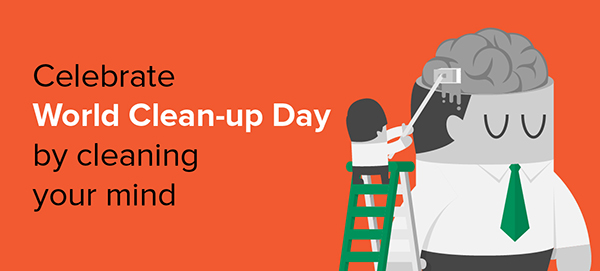
A very happy World Clean-up Day to you! What better way to celebrate the occasion than by cleaning up your mind. Our mind is full of unwanted thoughts and scenarios, and it’s time we took care of ourselves. Regular meditation, yoga and breathing exercises help in doing that but we are aware that not everyone is into them so here are some quick, simple ways to help you get started.
Ten terrific ways to clean up your mind
- Take a short break. When over occupied with thoughts and work, take a 10-minute break, plug in your earphones and listen to your favourite soundtrack. This doesn’t necessarily have to be a song. It could be some soothing instrumental music. A break actually allows you to relax and gives time to your subconscious mind to figure out solutions to the challenges you are facing.
- Start by creating a boundary between “work” and “home”. Make sure these don’t overlap. (You deserve some time for yourself). That applies to your work hours as well. When at work, work to the fullest without getting diverted. Complete all important and urgent tasks as early as possible so that you don’t have to stretch after office hours.
- Try journaling. Now this doesn’t have to be grammatically correct or long paragraphs. Just make sure to write down something that you are grateful for or something that made you smile. This will help you focus on the things that you have rather than the things you lack.
- Disconnect from technology. Notice things around you. Try to use all your senses when you do this. If you go for a walk, notice sounds that you hear, food/flowers that you may be able to smell, the surroundings you can see, the temperature that you are currently feeling.
- Reconnect with friends. Meeting old friends seems like a treat now days. However that doesn’t mean you can’t stay connected. Call a friend and reconnect. Sometimes when you do so, you may end up rebuilding lost bonds. Reconnecting can also help you divert your mind from your routine schedule and have conversations on a lighter note.
- Focus on your feelings, not their triggers. Write down about the things that disturb you and what they make you feel. Try to write about the emotions that they bring up in you and how you feel about them. Doing so will help you come in touch with reality and focus on your feelings and emotions rather than environmental triggers.
- Read a book. A book is always a good way to relax as well as learn new things. Stories sometimes take you to different places and enhance your imagination. A self-help book, on the other hand, can actually give you new insights and techniques to practise in your life.
- Banish unwelcome thoughts. Let go of unwanted thoughts by substituting them with desirable thoughts. Sometimes the unwanted thoughts are irrational. Develop a habit to immediately think of something desirable when such unwanted thoughts occur in your mind. Slowly, you will learn to involuntarily substitute the unwanted thoughts even without your knowledge. You can even use guided imagery, by imagining yourself in calm and relaxed settings that may appeal to you. You can imagine soothing scenes, places, or experiences in your mind to help you relax and focus. Best way is to speak your mind to someone close to you whom you trust. Articulating your thoughts itself tends to soothe you and help you be objective.
- Take out time for a hobby. It can be something that you used to indulge in as a child or have recently got interested in. You don’t have to be good at it; you just need to make sure you are enjoying the process. Taking out time for your hobbies will help you feel your best.
- Learn to say “No” and try to eliminate things which are stress inducing – whether it is negative news on television, demotivational talks, caffeine or processed food. Do not overburden yourself. Understand, focus and prioritise on the important and urgent things and only then move to the other items on your to do list. Making some changes in your daily habits could help you feel better.

| Published by Team Internal Communications |  |
| This newsletter is for internal circulation only. It may not be published, reproduced or quoted in part or in whole, nor may it be published on social media without prior consent. The content is strictly copyright and reproduction of the whole or part of it in any form is prohibited without written permission from the Internal Communications department of Sharekhan. | |
| Join us on |  |
 |
 |
 |
 |
 |